

Embroidery vs Printing: Which Logo Method Suits Your Apparel

T-shirts top the list of promotional products people are most excited to receive, chosen by 55% of consumers in the ASI Global Advertising Impressions Study 2026, so how the logo goes on matters. Across our catalogue, embroidery is mentioned in 480 product descriptions and screen printing in 286. This guide to embroidery vs printing explains how each method works, compares durability, detail, feel and cost, matches the method to each garment, and shows how to prepare artwork, with examples from our T-shirts and polo shirts range.
In practice, embroidery is the better choice for small logos on polos, caps, jackets and uniforms that need to look premium and last as long as the garment, while printing suits large, colourful or detailed designs, light T-shirts and event runs. Many brands use both: an embroidered chest logo and a printed back.
How embroidery and printing work
Embroidery stitches your design into the fabric with coloured thread. A digitiser turns the logo into a stitch file, and the machine sews it, so the result is raised, textured and part of the garment. Our printing methods page describes each technique we use.
Printing puts ink or film on the surface of the fabric. The main methods for apparel are:
- Screen printing: one screen per colour, bold and very durable, best for simple designs in a few colours. Our DTG vs screen printing guide compares it with digital printing.
- DTF (direct to film): the design is printed on film and pressed onto the garment, which handles full colour artwork on most fabrics. See our DTF printing page.
- DTG (direct to garment): an inkjet prints straight onto cotton, good for photos and gradients.
- Sublimation: dye becomes part of light polyester fabric, used for full colour sportswear and jerseys.
Planning a branded order?
Share your quantities, budget and deadline. We reply with options, mockups and a bulk price, plus free design help.
Embroidery vs printing compared

| Factor | Embroidery | Printing |
|---|---|---|
| Look and feel | Raised, textured, premium | Flat and smooth; soft hand with DTG and sublimation |
| Durability | Lasts as long as the garment; does not crack or peel | Screen print lasts well; film and digital prints can fade or crack after many hot washes |
| Detail and colour | Limited thread colours; fine lines and tiny text blur | Full colour, gradients, photos and fine detail |
| Design size | Best for small areas: chest, sleeve, cap front | Best for large areas: backs, fronts, all over designs |
| Fabric | Pique, twill, fleece, denim, canvas, heavier knits | Light cotton, polyester and performance fabrics |
| What sets the cost | Stitch count (size and density) and the one time digitising of the logo | Number of colours and print positions (screen), or print area (DTF, DTG) |
| Best for | Uniforms, polos, caps, jackets, executive gifts | Event T-shirts, campaigns, sportswear, colourful designs |
Which method suits each garment
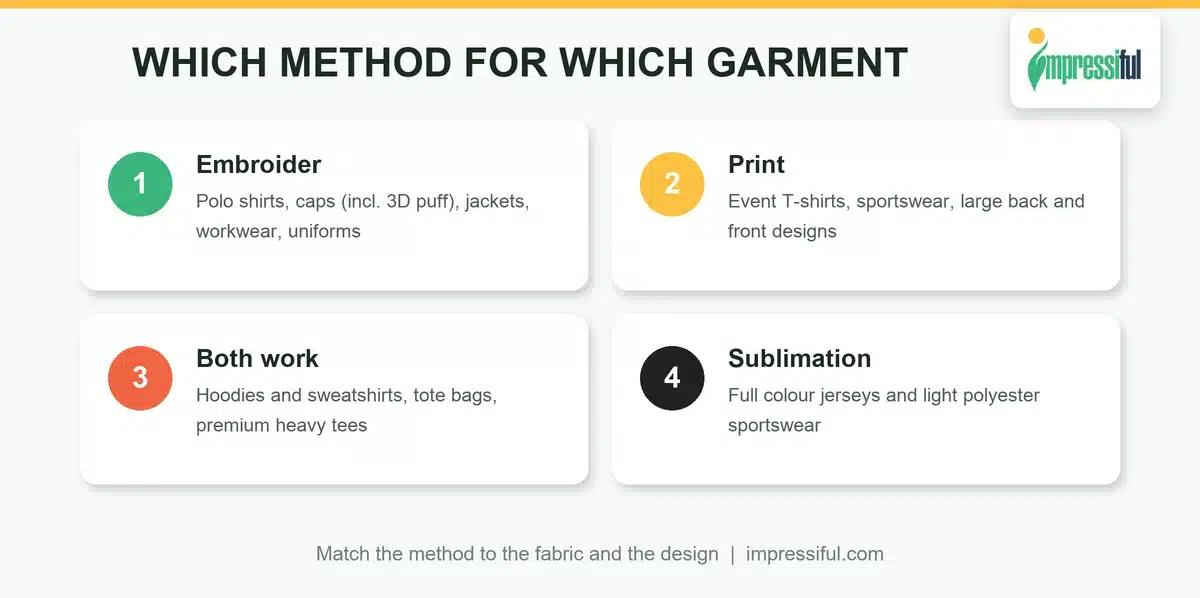
- Polo shirts: embroidery on the left chest is the classic choice for staff. Our guide to custom polo shirts in Dubai covers fabrics and placement.
- Caps: embroidery holds its shape on structured fronts, and 3D puff embroidery gives a raised, bold logo. See our custom caps guide.
- T-shirts: printing, because cotton jersey is light and event designs are often large and colourful. A small embroidered logo works on heavier premium tees.
- Hoodies and sweatshirts: both work. Fleece takes embroidery well for a chest logo; a large back design is better printed. Our custom hoodies guide shows the options.
- Jackets and workwear: embroidery survives industrial washing and daily wear. Our guide to custom uniforms in Dubai covers workwear for UAE teams.
- Sportswear and performance shirts: printing or sublimation, because embroidery adds weight and can feel stiff on thin, stretchy fabric. In the UAE summer, when the midday break for outdoor workers applies from 15 June, as The National reported, light breathable shirts with a printed logo are the practical choice for field teams.
- Tote bags: printing for large designs on cotton or canvas; embroidery for a small premium mark.
Disadvantages of each method
Embroidery is not right for every design. It cannot reproduce gradients or photos, very small text (as a rule of thumb, under about 5 mm tall) and hairlines lose their shape, and a large embroidered area is heavy and stiff. On thin fabrics the stitching can pucker, and the back of the design can feel rough against the skin unless it is backed.
Printing has its own limits. Prints sit on the surface, so cheaper film and digital prints can fade, crack or peel after many hot washes, and printing on textured fabrics such as pique or fleece is less sharp. Screen printing also needs a separate screen for every colour, which makes many colour designs expensive on small runs.
Durability and care
Colour fastness to washing is measured with ISO 105-C06, the international test for domestic and commercial laundering. Whatever the method, these habits keep the logo looking new:
- Wash inside out in cool or warm water and avoid bleach.
- Never iron directly on a print or on embroidery; iron on the reverse.
- Dry in the shade: strong UAE sun fades colours faster than washing.
- For uniforms washed often at high temperatures, choose embroidery or screen printing.
How to choose and prepare your artwork

- Look at the design: few colours and bold shapes suit embroidery; gradients, photos and fine detail need printing.
- Decide size and position: small chest, sleeve or cap logos suit embroidery; large backs and fronts suit printing.
- Check the fabric: heavy and textured fabrics take embroidery; light and stretchy fabrics take print.
- Think about washing: uniforms washed every day need the most durable method.
- Send a vector logo: an AI, EPS, SVG or PDF file gives the cleanest stitch file and print. If you only have an image, our team can prepare the artwork through request a design.
- Approve the proof: check the colours, size and position on a digital mockup before production.
Frequently asked questions
Is embroidery or print better?
Neither is better for everything: embroidery is better for a small, premium logo that must last, such as on polos, caps, jackets and uniforms, while printing is better for large, colourful or detailed designs on T-shirts and sportswear. Many brands combine both on one garment. Our printing methods page explains each option.
What are the disadvantages of embroidery?
Embroidery cannot show gradients or photos, and very small text and fine lines blur. Large embroidered areas are heavy and stiff, and thin or stretchy fabrics can pucker under the stitches. For those designs and fabrics, printing is usually the better choice.
Is embroidery more expensive than printing?
It depends on the design and the quantity. Embroidery is priced by stitch count, so a small chest logo can cost less than a large multi colour print, while a big embroidered design costs more than printing the same area. Your quote shows the price for each method, and our DTG vs screen printing guide explains how print costs work.
Which is better, DTF or embroidery?
DTF is better for detailed, full colour artwork, large designs and light fabrics, while embroidery is better for simple logos that need a premium, long lasting finish on heavier garments. DTF prints sit on the surface and can wear after many hot washes; embroidery lasts as long as the garment. See our DTF printing page for examples.
Get a free design proof
Send us your logo, the garments and quantities you have in mind, and we will recommend embroidery, printing or both, and send a free design proof and a quote with the price and delivery dates confirmed.
Prefer WhatsApp? Message +971 52 656 8355 and tell us what you need. Our office hours are Monday to Saturday, 9:30am to 7pm.