

Campaign T-Shirt Printing: Screen Printing vs DTF at 50, 500 and 5,000 Shirts

Campaign T shirt printing comes down to two methods for most orders: screen printing and DTF (direct to film). Screen printing has a set-up cost for every colour, then a low cost per shirt, so it gets cheaper the more you print. DTF has no screens to make, so it suits small runs and full colour designs such as a candidate’s photo.
So for 50 shirts with a multi-colour design, DTF is usually the more economical choice. For 500 shirts with a one or two colour logo, screen printing usually wins. At 5,000 shirts, screen printing is almost always cheaper per piece, unless every shirt needs a different name or number.
This campaign T shirt printing guide explains why, with a simple way to compare quotes at 50, 500 and 5,000 pieces, what published Kenyan price lists show on 27 November 2026, and the design choices that move the price most. It is written for parties, aspirants and campaign teams of every political affiliation.
Campaign T shirt printing: screen printing vs DTF at a glance
In practice, the two methods differ in how they build a print, and that sets the cost curve. Screen printing pushes ink through a mesh stencil, one screen for each colour. DTF prints the design onto a film, which is then heat pressed onto the shirt.
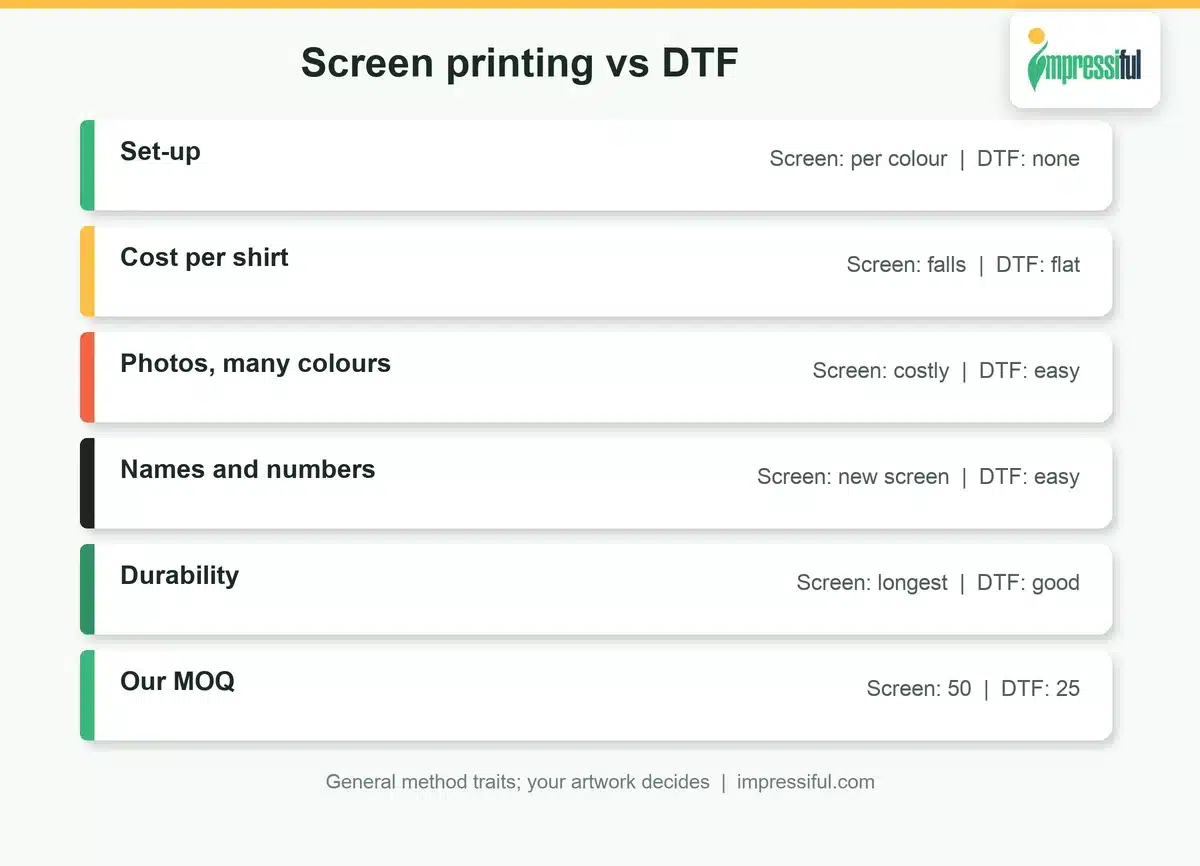
| Factor | Screen printing | DTF printing |
|---|---|---|
| Set-up | One screen per colour, per print position | No screens; the design is printed on film |
| Cost per shirt | Falls sharply as quantity rises | Fairly flat; depends mostly on print size |
| Colours and photos | Best with 1 to 3 solid colours | Full colour, gradients and photos at no extra set-up |
| Fabrics | Cotton and cotton blends | Cotton, polyester and blends |
| Durability and feel | Generally the longest wash life; ink sits in the fabric | Good when pressed properly; large solid areas can feel thicker |
| Names and numbers | Each change needs its own screen | Every shirt can be different |
| Our MOQ | 50 pieces | 25 pieces |
| Best run size | Hundreds to thousands of the same design | Tens to a few hundred, or mixed designs |
For the technical background, see our guides to what DTF printing is and screen printing vs DTG. This guide stays on the campaign question: which one is cheaper for your run size.
Planning a branded order?
Share your quantities, budget and deadline. We reply with options, mockups and a bulk price, plus free design help.
How to compare two quotes: the cost formula
Every quote for printed campaign shirts can be broken into the same parts. Ask each printer to split their price this way, and the comparison becomes simple.
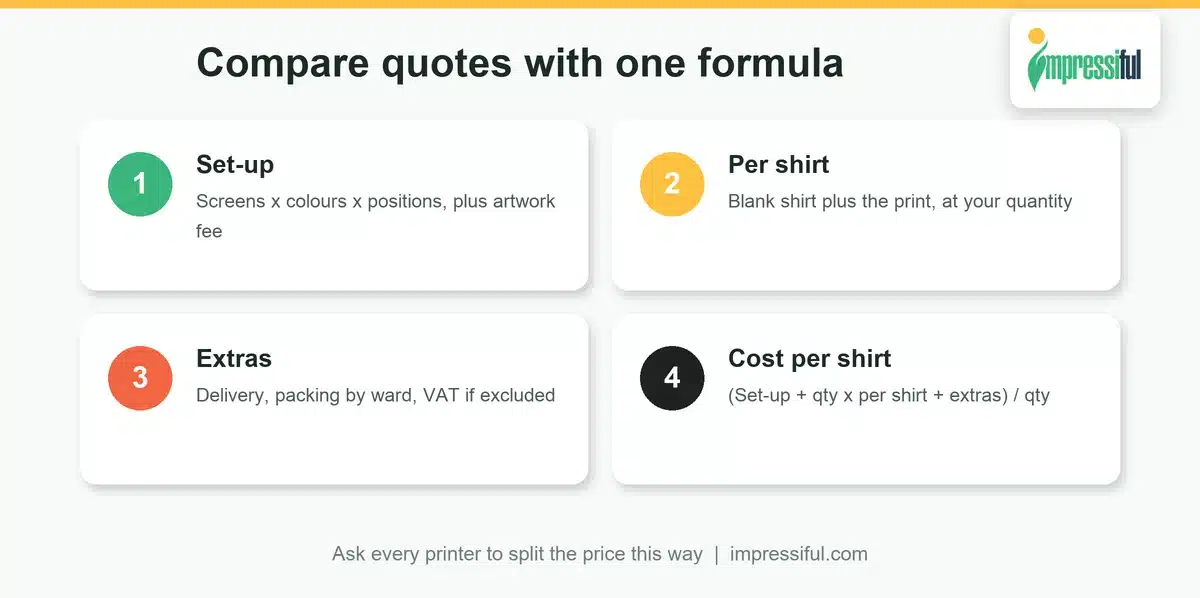
- Set-up: for screen printing, the number of colours multiplied by the number of print positions, plus any artwork fee. For DTF, usually only the artwork fee.
- Per shirt: the blank shirt plus the print. For screen printing this falls as the run grows; for DTF it moves mostly with the size of the print.
- Extras: delivery, packing by ward or county, and VAT if the quote excludes it.
Cost per shirt = (set-up + quantity x per shirt + extras) / quantity. The set-up is shared across every shirt, which is why a large screen run ends up so cheap per piece and a tiny one does not.
50, 500 and 5,000 shirts: which method usually wins
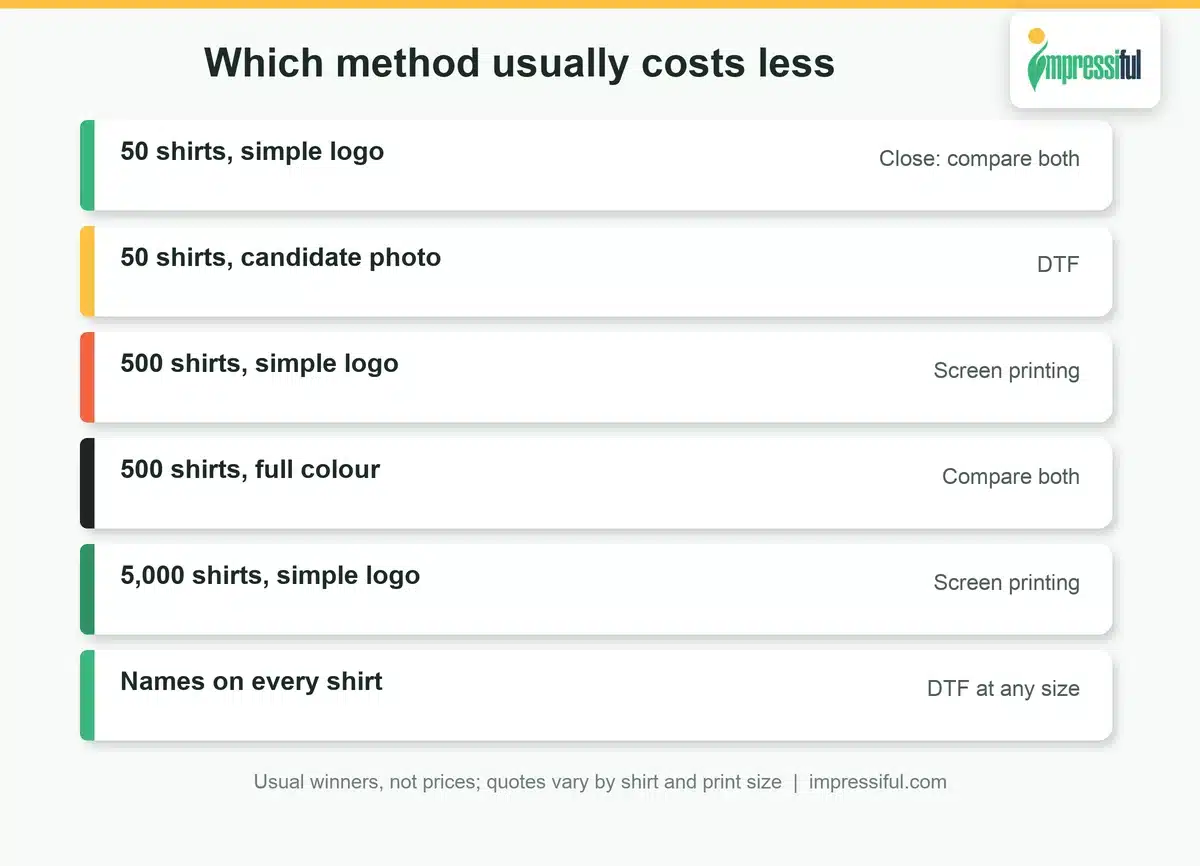
The table below applies that formula to the three run sizes campaigns ask about most. It shows the usual winner, not a price, because the numbers depend on the shirt, the colours and the print size in your brief.
| Run size | 1 or 2 colour logo and slogan | Full colour design or candidate photo | Why |
|---|---|---|---|
| 50 shirts (core team, agents in one ward) | Close; compare both quotes | DTF | Screen set-up is shared across only 50 shirts |
| 500 shirts (ward campaign, volunteers) | Screen printing | Compare both; DTF is often close | Screen set-up is now a small share of each shirt; many colours still add screens |
| 5,000 shirts (county or national rally stock) | Screen printing | Screen printing, if the photo can be simplified to a few colours | DTF per shirt cost hardly falls with volume |
Two cases break the pattern. If each shirt carries a different name, number or polling station, DTF is the practical choice at any size. If the design uses six or more colours on front and back, screen set-up grows quickly, so ask for both quotes even at 500.
What published Kenyan prices show
Kenyan printers publish their campaign shirt prices, which shows how quantity changes the price. On 27 November 2026, Google’s AI Overview for “campaign t shirt printing” in Kenya summed up sellers’ lists from KES 280 a shirt with a 50 piece minimum, to KES 450 for bulk orders from 50 pieces, and from KES 1,150 for a single shirt down to KES 800 each at 300 pieces including VAT. These are their prices, not ours.
One Kenyan election printer’s published list, which we recorded on 22 November 2026, shows the screen printing curve clearly: KES 380 a shirt at 50 pieces, 360 at 100, 330 at 500 and 280 at 1,000, plus a one-time KES 2,000 artwork fee. That is a fall of about 26% from 50 to 1,000 pieces, mostly because the set-up is shared across more shirts. Our campaign T-shirts Kenya price guide covers these lists and budget examples in full.
The same results show why method matters: the AI Overview advised screen printing for large runs with one or two colours, and DTF or sublimation for multi-colour designs, photos or smaller batches.
5 design choices that move the price most
- Number of colours: each extra colour adds a screen. A one colour logo in party colours keeps a large screen run cheapest.
- Print positions: front and back doubles the screens. A slogan on the back can be one colour even if the front is full colour.
- Candidate photo: a full colour photo favours DTF on short runs. For thousands of shirts, a simplified two or three colour portrait can be screen printed.
- Fabric: light polyester rally shirts suit DTF; cotton shirts take both methods well. Our T-shirt GSM guide explains fabric weights.
- Size split: order sizes to match the people who will wear them, so fewer shirts are wasted. Our T-shirt size breakdown gives a starting split.
Send artwork in the right format to avoid delays and extra artwork fees; our guide to print-ready artwork lists the files we need.
Timing: order before the campaign window
Campaign shirts are needed for the party primaries and again for the official campaign before the General Election on 10 August 2027. The Independent Electoral and Boundaries Commission (IEBC) publishes the timetable, and our Kenya election campaign period 2027 guide lists every gazetted date by seat.
If you order from outside Kenya, shipping sets your order date. Impressiful Shipping’s published sea estimate from the UAE to Mombasa is about 22 to 40 days, before production, approval, clearance and delivery inland; see their Dubai to Mombasa guide.
Rules to keep in mind
Branded shirts are a normal campaign material for every party. Kenya’s Election Offences Act, 2016 makes bribery of voters an offence, so how items are handed out can matter. We do not give legal advice: check distribution plans, slogans and campaign finance rules with your campaign’s legal team, and keep slogans free of hate speech or inflammatory content.
How Impressiful handles campaign T shirt printing
We print campaign merchandise in bulk for parties, candidates, aspirants and campaign teams, and our political campaign merchandise page lists the full range. What we can confirm today:
- Low MOQs: DTF printing from 25 pieces and screen printing from 50, so a small first batch for the core team is possible.
- Method advice: we recommend screen printing or DTF for your artwork and quantity when we quote.
- Free digital mockup of your design before you approve the order.
- Payment by bank transfer or payment link.
- Prices and timing: product price, production time and freight to Kenya are quoted per order.
For the full range of shirts, see our bulk custom T-shirt printing page.
Frequently asked questions
Which is better, screenprint or DTF?
Neither is better for every order. Screen printing is usually cheaper and longer lasting for large runs of a design with one to three solid colours, while DTF is better for small runs, full colour artwork such as a candidate photo, and shirts that each carry a different name. For a campaign, many teams use DTF for the first small batch and screen printing for rally stock; our DTF printing guide explains how the transfer is made.
What are the disadvantages of DTF?
The cost per shirt hardly falls as the order grows, so DTF loses to screen printing on very large runs. Large solid print areas can feel thicker than screen printed ink, and specialty finishes such as puff or metallic inks are a screen printing strength. Keeping the print to a sensible size, for example a chest logo with a back slogan, reduces both issues; see our print-ready artwork guide for sizing.
How long does DTF last vs screen printing?
Screen printing is generally seen as the most durable method, because the ink bonds into the fabric, and it is the usual choice for shirts that will be washed many times. A DTF print pressed at the right heat and pressure also holds up well through normal washing, which is enough for most campaign wear. Washing inside out in cool water helps both last longer, and the direct to film printing entry on Wikipedia describes how the film bonds to the fabric.
Get a quote for your campaign shirts
Send us your quantity, the number of colours, the print positions and your deadline. We will recommend screen printing or DTF, prepare a free digital mockup and send a written quote.
Prefer WhatsApp? Message +971 52 656 8355, or send your design through our design request page.