

What Is DTF Printing? DTF vs DTG vs Screen Printing Compared


T-shirts are the biggest product in branded merchandise: they make up 16.1% of annual promotional product spend in the US, according to ASI’s 2026 Ad Impressions Study. How the logo goes onto that shirt decides how it looks, feels and survives the wash. This guide answers what is DTF printing, how the process works step by step, how it compares with DTG and screen printing, which fabrics and products suit it, how to care for it and how to prepare artwork, so you can brief your next order of custom T-shirts and polo shirts with confidence.
In simple terms, DTF (direct to film) printing means your design is printed in colour onto a clear PET film, backed with white ink, coated with a hot melt adhesive powder and cured, then heat pressed onto the garment. Because the print is made on film first, DTF works on cotton, polyester and blends, dark or light, with full colour detail.
How DTF printing works, step by step
DTF separates printing from the garment. The design is made on film first and transferred later, which is why it handles so many fabrics. According to the Wikipedia entry on direct to film printing, the process has four stages.

- Print on film: the artwork is printed mirrored onto PET film with pigment CMYK inks, then a layer of white ink is printed behind it so colours stay bright on dark fabric.
- Add adhesive powder: while the ink is still wet, a fine thermoplastic polyurethane (TPU) hot melt powder is applied to the printed areas.
- Cure: the powder is melted and fused to the ink, which turns the print into a ready transfer.
- Press and peel: the transfer is heat pressed onto the garment at around 160 to 170°C for 10 to 15 seconds, then the film is peeled away, hot or cold depending on the film.
Our DTF printing service page explains how we apply this method to custom apparel and which artwork works best.
Planning a branded order?
Share your quantities, budget and deadline. We reply with options, mockups and a bulk price, plus free design help.
DTF vs DTG vs screen printing compared
All three methods put a full design on a garment, but they reach it in different ways. DTG (direct to garment) prints ink straight into the fabric like an inkjet printer, and screen printing pushes ink through a mesh stencil, one screen per colour.
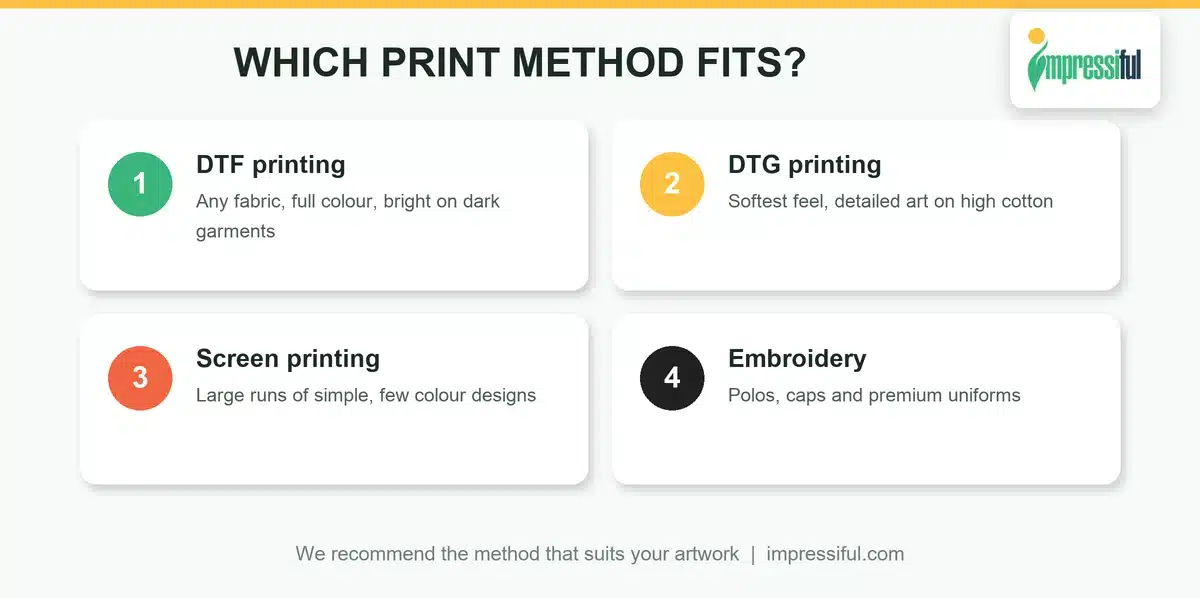
| Factor | DTF printing | DTG printing | Screen printing |
|---|---|---|---|
| How it works | Printed on film, then heat pressed | Printed directly into the fabric | Ink pushed through a stencil, one screen per colour |
| Fabrics | Cotton, polyester, blends, nylon, some leather | Best on high cotton fabric | Cotton, blends, fleece, canvas |
| Colours and detail | Full colour, gradients, fine lines | Full colour, photographic detail | Best with a few solid colours |
| Feel | Thin layer that sits on top of the fabric | Softest, ink is in the fibres | Thicker ink layer, smooth with good inks |
| Dark garments | Yes, white backing is built into the transfer | Yes, needs pretreatment | Yes, with an underbase colour |
| Set up | None per design | None per design | One screen per colour |
| Best fit | Short and mid runs, mixed fabrics, colourful logos | Short runs of detailed art on cotton | Large runs of simple designs |
For a deeper look at the other two methods, read our comparison of screen printing vs DTG. If you are choosing between thread and ink, our guide to embroidery vs printing covers that decision garment by garment.
What DTF printing is good for
DTF is at its best when the fabric or the design rules out other methods. It suits:
- Polyester and performance wear: sports shirts, team kits and dri fit polos, where DTG ink does not bond well.
- Dark garments with colourful logos: the white layer is part of the transfer, so colours stay bright on black or navy.
- Detailed artwork: gradients, small text and multicolour logos that would need many screens.
- Mixed orders: the same logo on T-shirts, hoodies, caps and tote bags, because one transfer type works across fabrics.
- Names and numbers: each transfer can be different, which helps for event staff shirts or team jerseys.
It is less suited to very large solid areas of print, where the film layer can feel heavy, and to garments that must feel like the print is part of the fabric. For polos where a printed logo is preferred over embroidery, our custom polo shirts guide explains the options.
Is DTF printing good quality and durable?
A well made DTF print is sharp, bright and flexible, and it should not crack or peel when the transfer is cured and pressed correctly. Quality depends on three things: the ink and film, an even powder layer and the right press temperature, time and pressure.
The main trade off is feel. The Wikipedia entry notes that DTF prints have a slightly plastic feel and sit on top of the fabric. Keeping large designs open (with gaps rather than one solid block) makes the shirt more breathable and comfortable in UAE heat.
For corporate buyers who want a measurable check, colour fastness to washing is tested to ISO 105-C06, and many buyers also ask for garments and inks certified to OEKO-TEX Standard 100 for items worn next to the skin.
How to care for DTF printed clothing
- Wash inside out in cold or warm water, not hot.
- Use a mild detergent and avoid bleach and fabric softener on the print.
- Tumble dry low or hang to dry, away from strong direct sun.
- Never iron directly on the print: iron inside out or with a cloth between.
How to prepare artwork for DTF printing
Good files are the biggest single factor in a good DTF print. Before you send your logo, check the points below.

- File type: a vector file (AI, EPS, SVG or PDF), or a PNG at 300 dpi at the final print size.
- Transparent background: anything not transparent will print, including white boxes around a logo.
- Clean edges: avoid soft shadows and semi transparent pixels, which can print as a faint halo.
- Fine detail: keep thin lines and small text thick enough to transfer cleanly; we will flag anything too fine on the proof.
- Colours: note your brand Pantone or CMYK values so the proof can be matched.
If you do not have a print ready file, our designers can redraw it. Send it through request a design and you will receive a free digital mockup showing size and position on the garment before anything is printed.
Frequently asked questions
Is DTF printing good quality?
Yes. When the transfer is printed, powdered, cured and pressed correctly, DTF gives sharp, bright, full colour prints that stay flexible and do not crack or peel easily. The print sits on top of the fabric, so it feels slightly firmer than DTG, which is why open designs are more comfortable than large solid blocks.
What is DTF printing used for?
DTF printing is used to put full colour designs on T-shirts, hoodies, polos, sportswear, caps, tote bags and other textiles, including polyester and blends. It is popular for colourful logos on dark garments and for orders that mix several products. See our custom tote bags guide for how it works on bags.
What is the difference between DTG and DTF printing?
DTG prints ink directly into the fabric, which feels very soft but works best on high cotton garments. DTF prints the design onto film first and heat presses it onto the garment, so it works on cotton, polyester and blends. In short, DTG wins on softness on cotton and DTF wins on fabric choice and colour on dark garments.
Which is cheaper, DTF or screen printing?
It depends on the quantity and the number of colours. DTF has no screens to make, so it is usually more economical for short and mid runs and for designs with many colours, while screen printing spreads its set up across the order and becomes more economical for large runs of simple designs. Our team will recommend the most cost effective method for your artwork when you request a quote.
Is DTF replacing screen printing?
No. DTF has grown fast since the early 2020s, but it complements screen printing rather than replacing it, as the direct to film printing entry on Wikipedia notes. DTF is strongest for fine detail, mixed fabrics and smaller runs, while screen printing remains a good fit for very large runs of simple designs.
Get a free design proof for your DTF printed apparel
Send us your logo, the garments you have in mind and your quantities, and we will recommend the right print method, share a free digital mockup and send a quote with price and delivery dates confirmed.
Get a free quote for DTF printing
Prefer WhatsApp? Message +971 52 656 8355 and tell us what you need. Our office hours are Monday to Saturday, 9:30am to 7pm.