

Custom Chef Coats Dubai: Fabrics, Styles and Logo Options for Kitchens


Custom chef coats Dubai kitchens order have to do two jobs at once: protect cooks from heat and splashes on long shifts, and show your brand every time a chef steps into an open kitchen or onto a hotel buffet. This custom chef coats Dubai guide covers the six choices that decide a good coat, the fabrics that cope with hot kitchens, styles and colours, hats and aprons, logo placement and care. Our uniforms and work apparel collection lists the chef coats, hats and aprons we brand.
In short, most restaurants do best with a breathable cotton or poly-cotton coat, long sleeves for the hot line, an embroidered logo on the chest and the chef’s name on the opposite side, and enough coats for every shift plus spares while others are in the wash. White still says “clean kitchen” to guests; darker colours suit open kitchens and teams that want to hide stains.
Custom chef coats Dubai kitchens order: 6 choices to make
Before you ask any supplier for a price, settle these six choices. They decide comfort, how the coat looks after fifty washes and how much the full order costs.
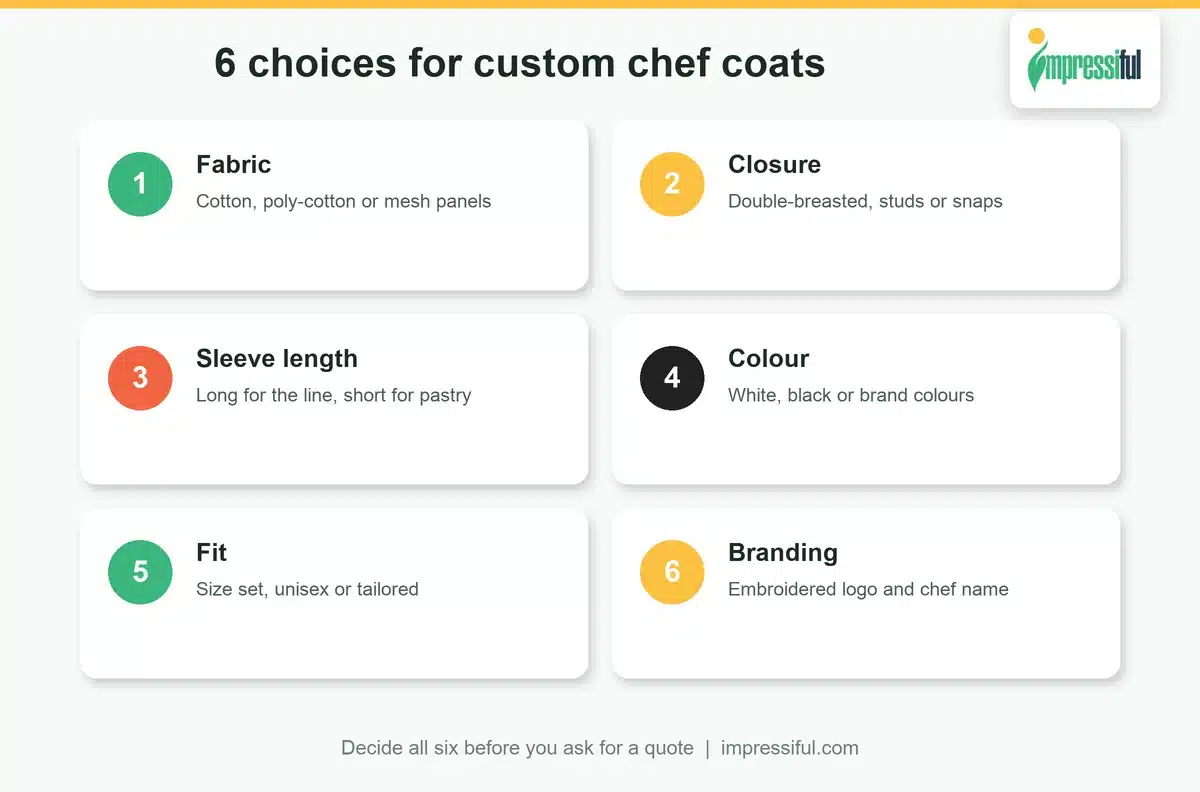
| Choice | Main options | What usually suits UAE kitchens |
|---|---|---|
| 1. Fabric | 100% cotton, poly-cotton blend, polyester with mesh panels | Breathable cotton or poly-cotton; mesh back panels for very hot stations |
| 2. Closure | Double-breasted buttons, studs, snaps | Double-breasted for the hot line; snaps for quick changes |
| 3. Sleeve length | Long, three quarter, short | Long for grills, fryers and woks; short for pastry, cold kitchen and service |
| 4. Colour | White, black, grey, brand colours | White for tradition and hotels; dark colours for open kitchens |
| 5. Fit | Unisex, men’s and women’s cuts, executive cut | A size set so the team can try sizes before the bulk order |
| 6. Branding | Embroidered logo, chef name, sleeve flag | Embroidery, because it survives hot washes |
If you are dressing the whole venue, our custom uniforms Dubai guide covers front of house, housekeeping and office uniforms alongside the kitchen.
Planning a branded order?
Share your quantities, budget and deadline. We reply with options, mockups and a bulk price, plus free design help.
Chef coat fabrics for hot kitchens
Fabric is the choice your chefs will feel every shift. The traditional chef’s jacket is made from thick cotton because it protects against the heat of stoves and ovens and against splashing liquids, as the history of the chef’s uniform explains. Modern chef coats balance that protection with breathability.
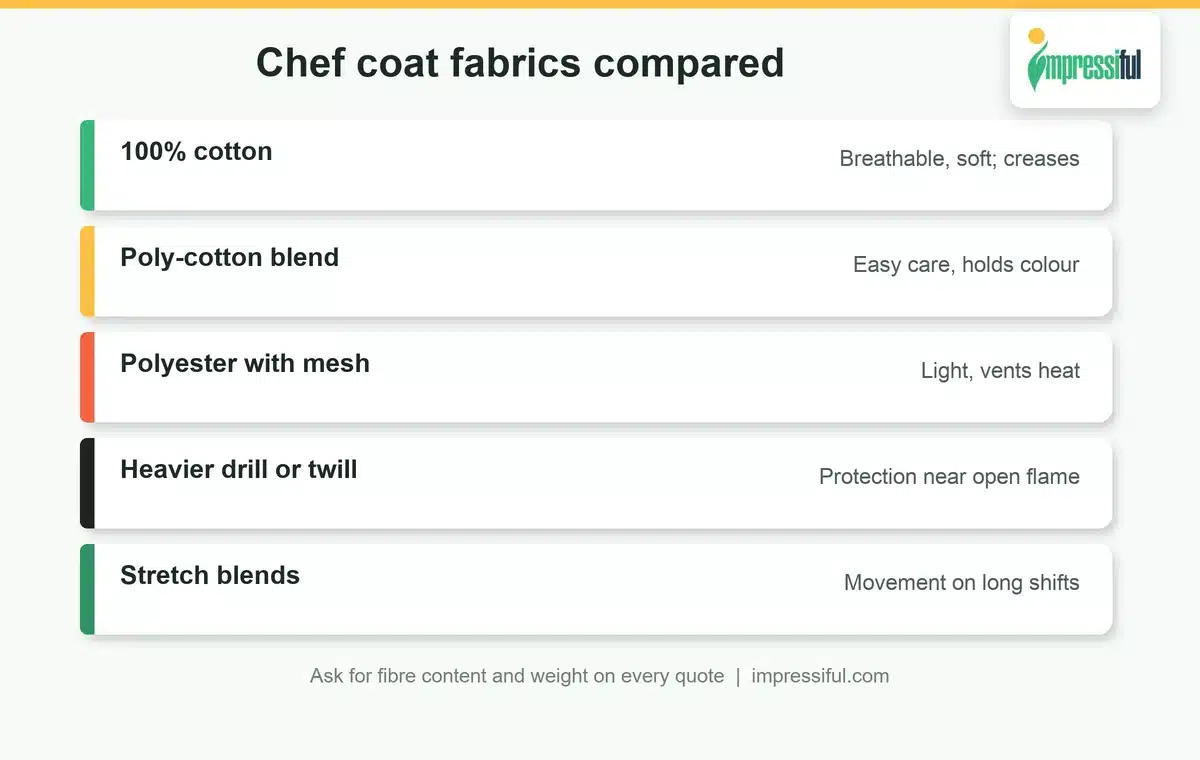
- 100% cotton: the most breathable and comfortable against the skin, and it does not melt near heat. It creases and can shrink, so wash carefully.
- Poly-cotton blend: the most common choice for busy kitchens. It keeps much of cotton’s comfort, holds its colour and shape, and dries faster. Our professional chef coat uses a cotton and polyester blend.
- Polyester with mesh panels: light and quick drying, with mesh at the back or underarms to vent heat. Keep it away from open flame, because polyester can melt.
- Heavier drill or twill: a tighter, thicker weave for grill and tandoor stations where splashes and radiant heat are constant.
- Stretch blends: a small share of stretch fibre helps chefs who move, lift and bend all shift.
Ask every supplier for the fibre content and fabric weight on the quote, not just “premium fabric”. If a supplier claims a textile certification, ask to see it; labels such as OEKO-TEX Standard 100 can be checked online. Our t-shirt GSM guide explains how fabric weight changes the feel of a garment.
Styles and colours for chef coats
The double-breasted chef coat is not just tradition. Two layers of fabric across the chest add protection from heat and spills, and the front can be buttoned the other way to hide a stain before service. Knotted cloth buttons were used because they survive frequent washing and contact with hot items; today most coats use heat resistant studs or snaps.
Executive, line cook and pastry styles
Many kitchens use the coat to show the brigade. Head chefs often wear a longer, tailored executive coat with piping or a contrast collar, line cooks wear a standard double-breasted coat, and pastry or cold kitchen teams wear short sleeves. Our culinary chef coat is double-breasted with heat resistant buttons, a sleeve pocket, a stand-up collar and adjustable cuffs.
White, black or brand colours?
White was chosen for the chef’s coat to signal cleanliness, and it is still the standard in hotels and fine dining. Black and grey chef coats hide stains and suit open kitchens, food trucks and modern concepts. Brand colours work well on piping, collars or aprons while the coat stays neutral. There is no rule that a colour means a rank; each kitchen sets its own code, so write yours down before you order.
Complete the kit: chef hats and aprons
A branded coat looks unfinished next to a mismatched hat or apron. Order the whole kitchen kit together so the logo and colours match at every station.
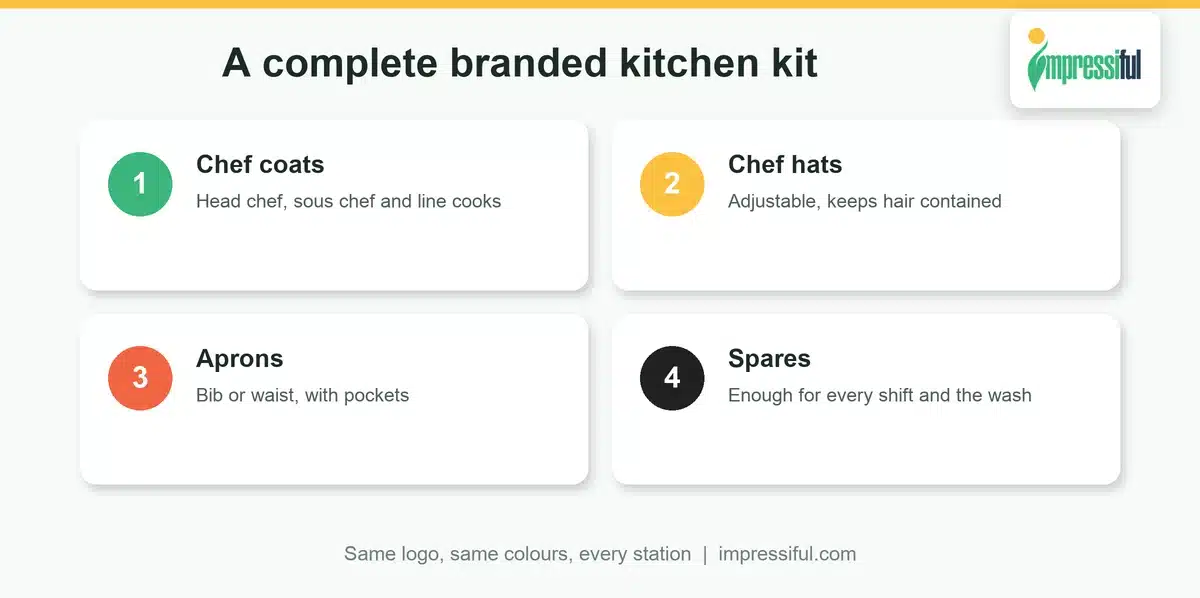
- Chef hats: our adjustable chef hats and custom chef hat keep hair contained and can carry your logo.
- Aprons: a waist apron suits servers and baristas, while a full kitchen apron protects the coat itself.
- Spares: plan enough coats for every shift a chef works in a week, plus spares while others are being washed.
Branding chef coats: embroidery and placement
Embroidery is the usual choice for chef coats because the stitches survive hot washes and pressing better than most prints. The classic layout is the restaurant logo on the left chest and the chef’s name, sometimes with a title such as Executive Chef, on the right chest. A small flag or second logo on the sleeve suits hotel groups with several outlets.
- Keep the logo simple, ideally one or two colours, so it stays sharp in thread.
- Avoid placing embroidery where the apron strap or bib will cover it.
- Check that names are spelled correctly before production; a name list is part of the approval.
Our embroidery vs printing guide compares both methods, and our printing methods page explains each technique we use. Embroidery is priced by the complexity of the design, and the price shows in our design tool. If you do not have a print ready logo yet, you can request a design from our team.
Caring for chef coats
Good care doubles the life of a coat. Wash chef coats after every shift, pre-treat grease stains quickly, and follow the care label for water temperature, because hot washes can shrink cotton. Wash white coats separately from coloured ones, turn embroidered coats inside out, and avoid strong bleach on embroidery and coloured piping. Hang or iron coats promptly so the poly-cotton dries without deep creases.
How to order custom chef coats from Impressiful
- Send your roles, sizes and quantities, your logo and any chef names through our bulk orders page.
- Choose the coat style, for example our professional chef coat with button or snap closures, plus hats and aprons.
- Our design team prepares the design free of charge and sends a preview to approve.
- When you confirm the order, you receive a sample kit before production; it is mainly digital, with branded mockups and product details. Samples requested without a confirmed order are charged.
- Delivery in the UAE takes about 3 days, about 5 days or about 2 weeks from the order date depending on the method, and shipping is free on orders from AED 500.
We work with low MOQs, orders of 100 pieces or more can get up to 60% off, and new customers can use WELCOME25 for 25% off a first order. For polo shirts for front of house teams, see our custom polo shirts guide, and to compare suppliers, read our guide to the best uniform company in Dubai.
Frequently asked questions
What fabric is used for chef coats?
Chef coats are usually made from 100% cotton, a poly-cotton blend or polyester with mesh panels. Cotton is the most breathable and handles heat well, poly-cotton is easier to care for and holds its colour, and lightweight polyester with mesh vents heat but should be kept away from open flame.
What should a chef wear in the kitchen?
A chef should wear a chef coat, ideally double-breasted with long sleeves for protection, kitchen trousers, a hat or hair covering, an apron and closed, non-slip shoes. The outfit protects against heat, splashes and spills, and keeps hair and clothing away from food.
Why do chefs wear white coats?
Chefs wear white coats mainly to signal cleanliness, a tradition that dates back to the 19th century. White also shows any stain straight away, so it is changed when it gets dirty, and the double-breasted front can be reversed to hide a mark before service.
Do different chef coat colors mean anything?
There is no universal colour code for chef coats. White is the classic choice in hotels and fine dining, black and grey hide stains in open kitchens, and some kitchens use a different colour or piping for the head chef or pastry team. Each kitchen decides its own colours.
Get a free quote for custom chef coats
Send us your roles, sizes, logo and chef names, and we will confirm styles, branding, price and the delivery date in writing.
Get a free quote for chef coats
Prefer WhatsApp? Message +971 52 656 8355. Our office is at Office C1-1F-SF3340, Ajman Free Zone C1 Building, Ajman, UAE, open Monday to Saturday, 9:30am to 7pm.