

Private Label vs White Label: Which Suits Your Brand?


Private label vs white label comes down to who owns the product. A private label product is made to your specification and sold only under your brand. A white label product is a ready-made, generic item that many sellers buy and rebrand. Private label costs more and takes longer, but no competitor can sell the same thing.
This private label vs white label guide is written for UAE founders and brands deciding how to launch a clothing or merchandise line. We add our own numbers: on 23 November 2026 our UAE catalogue listed 461 uniform and work apparel listings, 301 T-shirt and polo listings and 213 jacket and vest listings, the kind of stock items that can carry your logo straight away. Below you will find a side by side table, where OEM fits, a decision table and the UAE paperwork to check first.
Private label vs white label: the differences at a glance
In practice, the two models answer different questions. White label asks “which existing product can I put my name on?”, while private label asks “what product do I want made for my brand?”. Google’s AI Overview for this search sums it up the same way: white label items are pre-made and sold to many brands, private label items are custom-made or modified for one brand.
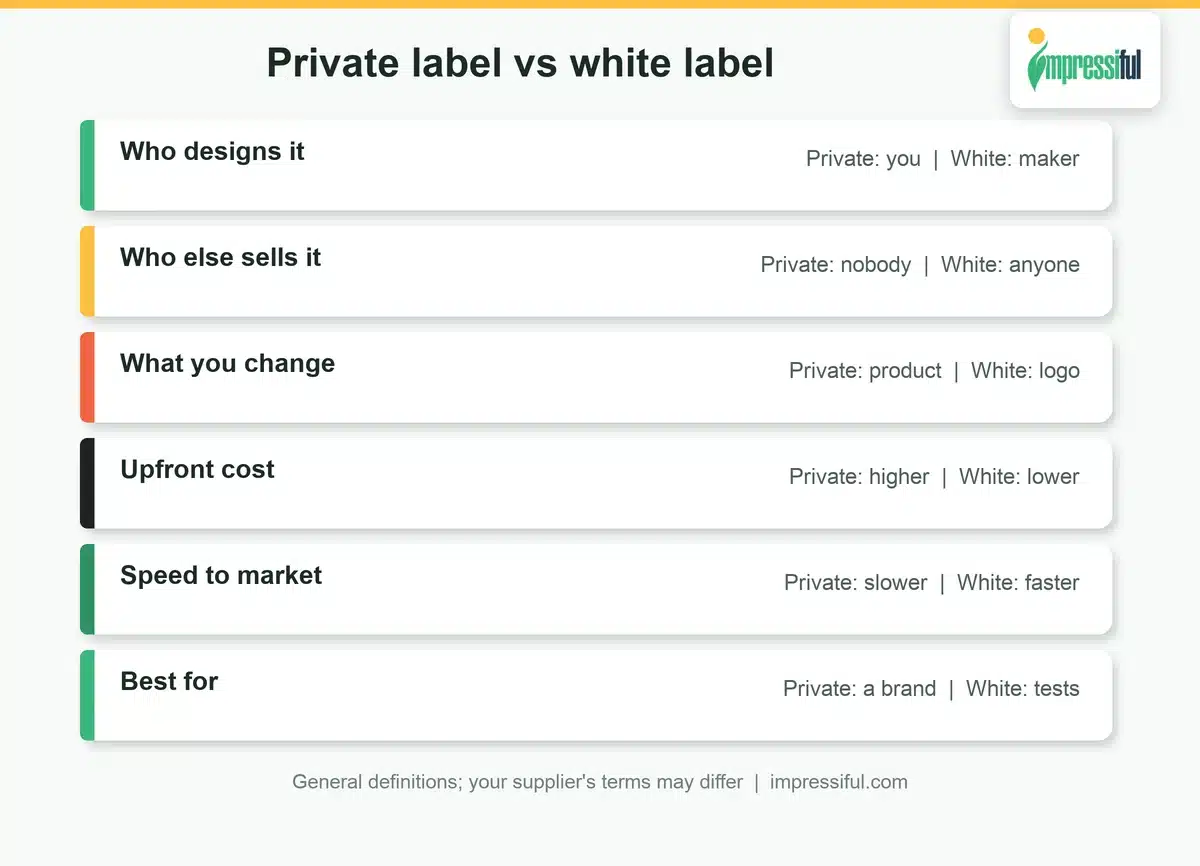
| Question | Private label | White label |
|---|---|---|
| Who designs the product? | You, or the manufacturer to your brief | The manufacturer; you choose from what exists |
| Who else can sell it? | Only your brand | Any seller who buys the same item |
| What can you change? | Fabric, fit, colours, trims, labels, packaging | Mostly the logo, label and packaging |
| Upfront cost | Higher: samples, development and a minimum run | Lower: the product already exists |
| Speed to market | Slower: design, sampling and production | Faster: brand it and sell it |
| Price competition | Lower, because the product is yours | Higher, because buyers can compare the same item |
| Best for | Building a distinct brand you plan to grow | Testing demand or adding range quickly |
Neither model is better in every case. Many brands start with white label items to test a market, then move their best sellers into private label once they know what customers want.
Planning a branded order?
Share your quantities, budget and deadline. We reply with options, mockups and a bulk price, plus free design help.
What private label means
We use the plain definition: private label is producing products for a customer under that customer’s own brand. You decide what the product is, the manufacturer makes it, and it carries your name, your neck label and your packaging. Nobody else is entitled to sell that exact product.
For clothing, private label usually means choosing the fabric weight, the cut and fit, the colours, the stitching details and the labels. A brand might ask for a 220 GSM cotton tee with a relaxed fit, a printed neck label instead of a sewn tag, and its own swing tags and polybags. Our guide to T-shirt GSM explains how fabric weight changes the feel and the price.
The trade off is commitment. Private label needs samples, sign-off at each stage and a minimum production run, so the money goes in before the first sale. In return you get a product your competitors cannot copy off the same shelf.
What white label means
White label products are generic items made in volume and sold to many sellers, who add their own branding. The product itself does not change from one seller to the next. Only the logo, the label or the packaging does.
In merchandise, the closest everyday example is a stock T-shirt, polo, cap or bottle with your logo printed or embroidered on it. That is how most corporate and event merchandise is made: you pick a ready product, approve a mockup and order. It is quick and the minimum quantities are low, but another company can order the same blank with a different logo.
White label is a sensible way to test a design, a colour or a price point before you invest in development. It is also the right choice when the logo matters more than the garment, for example staff uniforms or event shirts.
Where OEM fits: private label vs white label vs contract manufacturing
“People also search for” on Google pairs this question with contract manufacturing, and the terms are often mixed up. OEM (original equipment manufacturing), also called contract manufacturing, means a factory builds a product to a design that you supply in full, often including your own patterns, tech packs and materials.
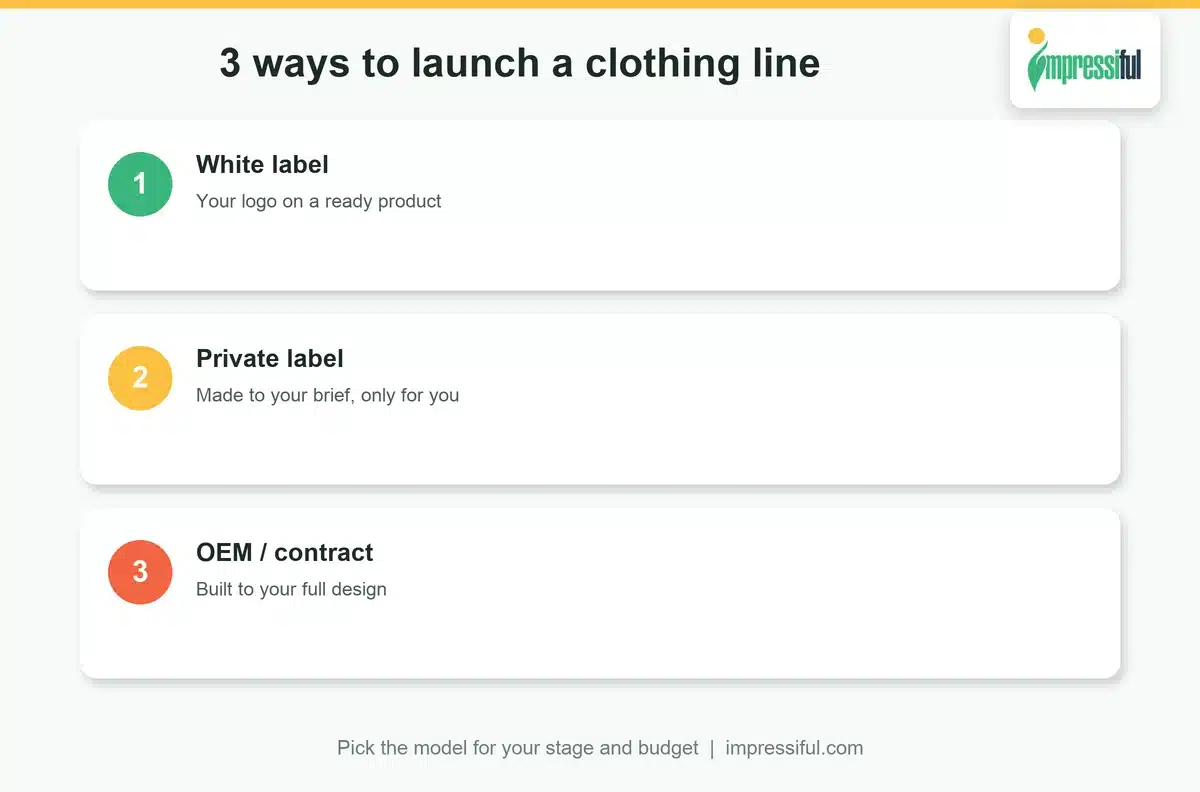
| Model | Your input | Control | Typical use |
|---|---|---|---|
| White label | Logo and packaging | Low | Merchandise, staff and event apparel, first product tests |
| Private label | A brief: fabric, fit, colours, labels | Medium to high | Clothing and lifestyle brands building their own range |
| OEM or contract manufacturing | A complete design and specification | Highest | Established brands with their own design team |
Private label sits in the middle. The manufacturer brings its patterns, fabrics and production know-how, and you shape them into a product that is yours.
Which model suits your brand?
The right answer depends on your stage, your budget and how much the product itself is the reason people buy. These situations come up most often when founders ask us about launching a line.
| Your situation | Usually the better fit | Why |
|---|---|---|
| You need staff uniforms or event shirts with your logo | White label | The garment is a carrier for the logo; speed and low MOQs matter |
| You want to test whether a design sells | White label first | Low risk; move to private label once demand is proven |
| You are launching a clothing brand people buy for the product | Private label | Fit, fabric and finish are the brand; exclusivity protects your price |
| You sell online and compete on comparison sites | Private label | Buyers cannot find the same item cheaper elsewhere |
| You have your own designers and tech packs | OEM | You control every detail; the factory follows your specification |
For a wider view of what to look for in a manufacturing partner, see our guide to the best clothing suppliers in the UAE.
Is private label still profitable?
It can be, but the profit comes from the brand, not from the label alone. Search results and AI answers agree on the levers: private label gives you pricing power because shoppers cannot compare the identical item elsewhere, while white label sellers often compete on price for the same product.
Three things decide whether it pays in practice. First, the minimum run: money is tied up in stock until it sells. Second, sell-through: a smaller first run in your best sizes and colours protects cash. Third, repeat orders: once samples and patterns are approved, reorders are simpler than the first order. Our T-shirt size breakdown helps you split a first run so fewer pieces are left over.
Before you launch in the UAE: 4 checks
A private label product carries your name, so the legal and tax side is yours too. This is general information, not legal or tax advice.
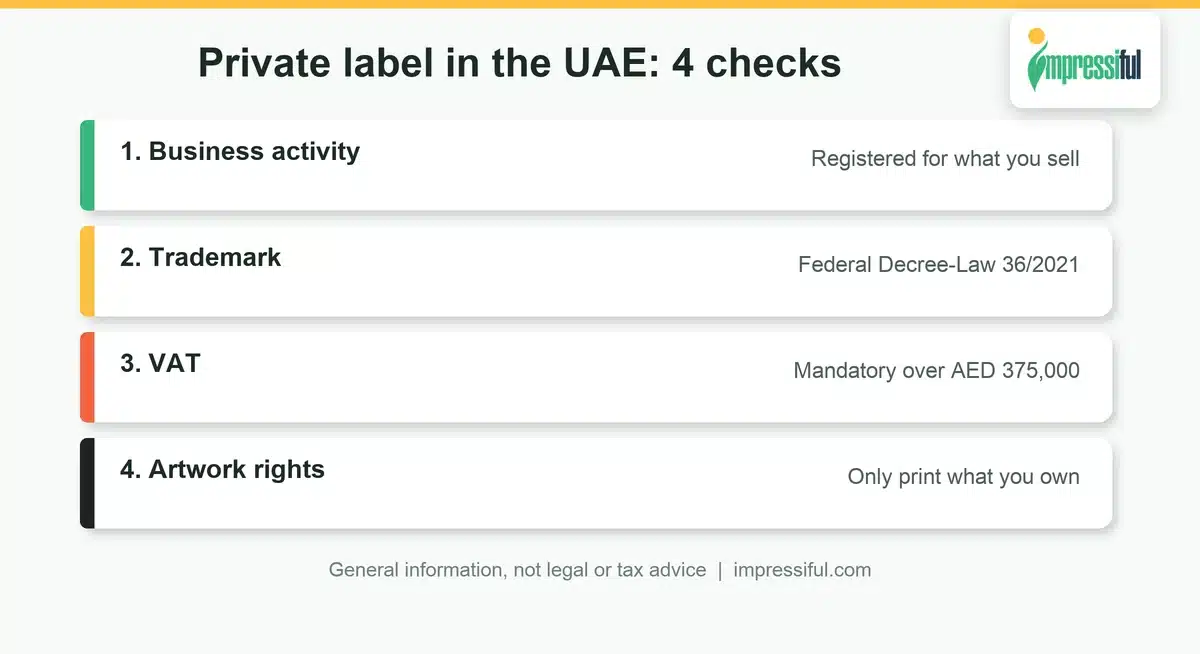
- Business activity: make sure the activities registered for your company cover what you plan, such as trading in clothing or selling online.
- Trademark: register your brand name and logo before you print thousands of labels. Trademarks in the UAE are governed by Federal Decree-Law No. 36 of 2021, listed with the other intellectual property legislation on the Ministry of Economy and Tourism site.
- VAT: registration becomes mandatory once taxable supplies pass AED 375,000 a year, as the Federal Tax Authority explains.
- Artwork you own: only print logos, slogans and designs you have the right to use. Our guide on whether it is illegal to print a logo on a shirt covers trademark and copyright in the UAE.
How private label works with Impressiful
We offer both routes, so you can start with one and move to the other. Here is what we can confirm:
- Private label: we produce products under your own brand. The minimum is 100 pieces, and timing and cost depend on the production details, so both are quoted per order on our private label page.
- Your logo on stock items: low MOQs by method: 25 pieces for DTF printing, 50 for screen printing, and embroidery with no MOQ, from AED 2.50 a piece depending on quantity and design. See our uniforms and work apparel range.
- Mockup first: a free digital mockup before you approve anything.
- Offers and payment: up to 60% off from 100 pieces, 25% off your first order, and payment by bank transfer or payment link.
Not sure whether to print or embroider your logo? Our guide to embroidery vs printing compares the two.
Frequently asked questions
Is private label the same as white label?
No. A private label product is made to your specification and sold only under your brand, while a white label product is a generic item that many sellers buy and rebrand. Both carry your name, but only private label gives you a product competitors cannot buy from the same source. A logo printed on a stock T-shirt or polo works like white label.
What is an example of a private label?
A typical example is a clothing brand that asks a manufacturer for a T-shirt in its own fabric weight, fit and colours, with its own neck label, swing tag and packaging. Supermarket own brands work the same way. Our private label service produces apparel under the customer’s own brand.
Is private label still profitable?
It can be, because an exclusive product protects your price from direct comparison. Profit depends on the minimum run, how quickly the stock sells and repeat orders, so many brands start small in their best sizes and colours. Check your VAT position with the Federal Tax Authority as sales grow.
Start your private label or branded range
Tell us what you want to make, the quantities and your target date. We will tell you whether private label or branding a stock item suits you better, prepare a free digital mockup and send a written quote.
Prefer WhatsApp? Message +971 52 656 8355, or send your logo through our design request page.